

When my English professor approached me and asked me to share my story, I remember feeling hesitant. Revealing something so personal felt overwhelming, and I wasn’t sure I was ready to put it into words for others to read.
She encouraged me repeatedly, and eventually I agreed and submitted it, though reluctantly. I did so hoping that those who knew me would never come across such a personal account. That hope never materialized, as many people—friends, classmates, and professors reached out to me afterward, thanking me for sharing my story. They spoke about how it resonated with them and how it reflected a deeper story shaped by culture and my experience. The thanks I received felt strange, largely because the story—though meant to be about me—contained very little about me. Instead, it followed the true story of a small, miniature drum.
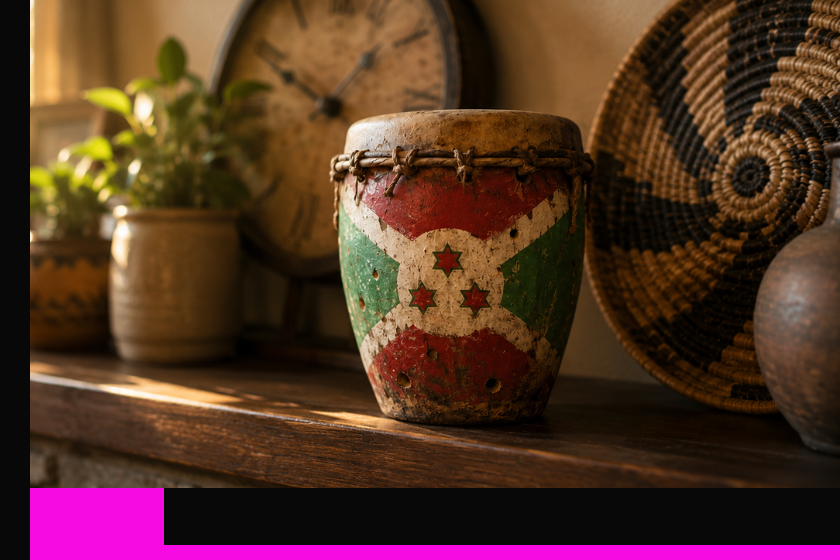
On a shelf above the fireplace in my home sits a small drum. It is easy to miss the drum among the beauty of a handcrafted basket, a rustic clock, and a flower pot that surrounds it, yet for me it is the most valuable item in the room.
The drum is worn with age. Its paint is faded, dirt is permanently embedded in its surface, and small holes mark the back. To most visitors, it might appear to be nothing more than a simple decoration from another country. Yet this little drum carries a story far greater than itself.
Painted across its worn surface are the colors of Burundi—red, white, and green. The drum is, by most standards, unremarkable, even unappealing, and one might pause to wonder why such an object is kept in the quiet center of my living room at all.
My mother bought this drum shortly before the war broke out in Burundi—a conflict that would soon spill into the streets and fracture everyday life. As the violence intensified and Burundians fled the sudden, sporadic gunfire, there was no time to return home for food, money, or basic necessities.
My family, like many others, was displaced into the wilderness, seeking refuge far from home. In the midst of that chaos—while my mother and father did everything they could to protect their
five children from the violence—it was not food or water that my mother instinctively carried with her. It was the drum. In the cold, damp darkness of the forest, surrounded by uncertainty and hunger, she would later wonder why she had not clung instead to something that could sustain life. Yet the drum remained.
While the drum could not physically sustain my family on the journey, it sustained them in a deeper, spiritual way. Along the road to the refugee camp, children, men, and women would gather around it, playing it together and singing songs of praise and worship until the moment they arrived.
Yet for many, arrival at the refugee camp was not an end of suffering, but the beginning of another trial. Though it marked survival, it also became a place where broken families—many who had lost loved ones—were forced to coexist amid hunger, grief, and uncertainty.I was born in that same refugee camp. I too grew up with that drum. I watched it bring moments of joy in places marked by sorrow, its sound cutting through hardship. Even in the most fragile circumstances, it carried laughter, rhythm, and brief but powerful glimpses of hope. From a space scattered with survival to a space scattered with hope, the drum endured—becoming a memento, a resonant reminder of the past, reaching forward into a greater future.
For many people, multiculturalism is celebrated through food, clothing, music, and language. While these expressions are beautiful, they often represent something deeper. Behind every culture is a story. Behind every accent is a journey shaped by place, people, and time. Behind every family tradition is a history of joys, struggles, sacrifices, and faith.
That small drum above my fireplace reminds me that I am part of a story much larger than myself—a story of displacement and belonging, loss and hope, and God’s faithfulness through every chapter. As we celebrate Multicultural Sabbath, we are reminded that each person in our church carries a unique story and heritage. Together, these stories reflect the beauty of God’s diverse family, united not by where we come from, but by the One who calls us His children.