

By Ptr. Rhoda Klein Miller
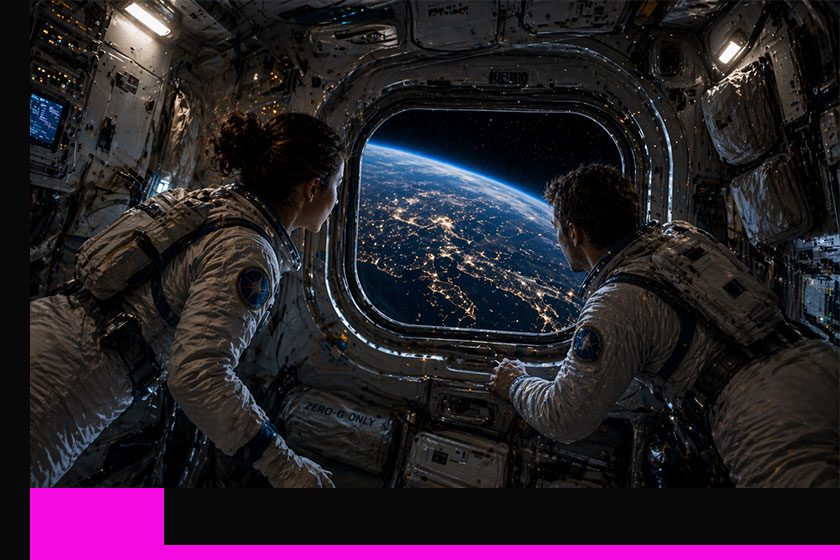
When astronauts from the Apollo program first looked back at Earth from the edge of space, they struggled to find words. One image in particular—captured during Apollo 8 and later known as Earthrise—shifted something in the human imagination. Astronaut Jim Lovell put it simply: “The vast loneliness is awe-inspiring, and it makes you realize just what you have back there on Earth.”
That realization has only deepened with modern space exploration. Even now, as NASA and the Canadian Space Agency push toward long-term presence on the Moon, the reality is sobering. There’s no breathable air. No real protection. No easy way to sustain life. Any hope of living there depends on building complex systems just to survive what Earth gives freely.
The farther we reach into space, the more we rediscover how uniquely habitable Earth is. The big takeaway isn’t “space is exciting.” It’s: Earth is irreplaceable.
Some have described our planet as a “lifeboat” in a vast cosmic ocean—a fragile, self-contained world where everything needed for life is held in delicate balance. That idea echoes across generations of astronauts and scientists who’ve seen Earth from afar. It’s not just poetic. It’s precisely true. And it raises a deeper question.
If there is nowhere else like this for our bodies to live—what about our souls?
In the Gospel of John chapter 6, we read how the crowd starts to leave Jesus. His teaching gets hard. The moment loses its hype. And Jesus turns to His disciples and asks, “Are you going to leave too?”
It’s Simon Peter who answers, “Lord, who else would we turn to? Only You have the words of eternal life.” It’s the confession of someone who has looked around and realized: there is nowhere else.
Just as astronauts come back with a renewed sense that Earth is not easily replaced, Peter comes to see that Jesus is not easily substituted. Christ is not one option among many spiritual paths. He is, in Peter’s words, the only source of “the words of eternal life”—life not just sustained, but abundant.
We live in a culture of endless alternatives. If something doesn’t work, we switch. If something feels demanding, we move on. But both space exploration and the gospel confront us with the truth. Life is precious and can’t be manifested.
Earth is something special. And so is Jesus.
He’s not one meaningful path among many. He’s the source of life itself—life that isn’t just sustained, but full, whole, and overflowing.
So perhaps the invitation is not just to admire the beauty of our “lifeboat” planet, but to stand in awe of that gift. To recognize that just as we rely on unseen forces—the atmosphere, magnetic fields, ecosystems—to sustain our physical lives, we also depend on God to sustain our spiritual lives.
So the invitation isn’t just to believe that in theory. It’s to live like it’s true.
To stop orbiting the edges of faith. To stop treating church like optional add-on spirituality.
To recognize that if Jesus actually holds life, then following Him isn’t occasional—it’s foundational.
Because at some point, each of us answers the same question:
Where else would I go?
And how we live is our answer.