

by Pastor Rhoda featuring a poem by Basil Williams
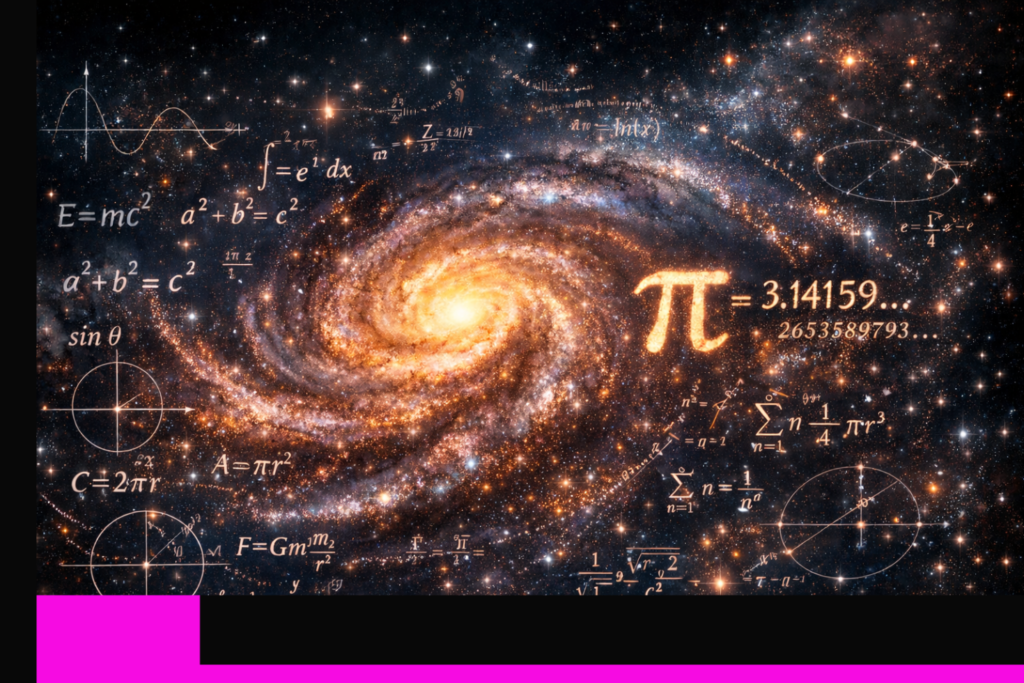
Every year on March 14 (3.14) math lovers celebrate Pi (π), the mysterious number that describes the ratio between the circumference of a circle and its diameter. The calculation will result in 3.14159265358979323846…
What is so unique about this value is that it is endless and no sequence of numbers ever repeat. For mathematicians, that endless string of digits evokes awe. For the rest of us, it’s mostly an excuse to eat pie. And for this nerdy pastor, Pi Day offers a good opportunity to reflect on faith, creation, and the God who made a universe full of elegant patterns.
Look around the natural world and you start noticing something remarkable: the universe runs on mathematics. The motion of planets, the rhythm of ocean tides, the structure of crystals, and the shape of galaxies all follow mathematical relationships.
For some people, faith and science feel like opposites. But many of history’s great scientists saw their work as exploring God’s handiwork. The astronomer Johannes Kepler once said that studying the universe meant “thinking God’s thoughts after Him.” In other words, when we discover mathematical beauty in creation, we’re uncovering patterns that were already there.
Circles and spheres appear everywhere in our universe —from seeds to planets. Why circles? Because circles and spheres are mathematically special. They are perfectly balanced shapes. Every point on a circle is exactly the same distance from the center.
Physics tells us spheres naturally form when forces distribute evenly in every direction. Ancient thinkers often saw spheres as symbols of perfection and completeness. And every time a circle appears, Pi is there too.
Even the Bible mentions Pi – kind of. When the temple built by Solomon is described in 1 Kings 7:23, it mentions a large circular basin: “It was ten cubits from brim to brim, circular in form… and thirty cubits in circumference.” Mathematically, that suggests a value of about 3 for Pi.
While not precise enough to pass a math test, ancient descriptions rounded measurements, and the passage was focused on architecture, not publishing a geometry textbook. It’s neat to see thousands of years ago people were already thinking about circular measurements that point to Pi.
More directly the nature of Pi parallels the Biblical description of God as beyond measure. His love is immeasurable. His wisdom is unsearchable. His mercy never runs out.
Job 11:7–9 asks“Can you fathom the mysteries of God? Can you probe the limits of the Almighty? They are higher than the heavens… deeper than the depths below.”
The mathematician may stare at an infinite decimal expansion. The believer sees a small hint of a God whose greatness can never be fully exhausted. Every time we think we’ve reached the end, there’s more.
Below is a poem by math teacher and OAC member, Basil Williams
Eyes of Mathematics
The ingenuity of man has power untold
A mathematical innerverse resounding
Unbounded increase of understanding
Given time all mysteries will unfold
That physics has permission to behold
Truths found through diligent proofing
Our intellect elegantly growing
Reaching far into the void and the cold
In a singularity now unfolded
The many functions contrived by God
Have consumed many lives and left unsolved
The eyes of math are infinitely broad
Without and within able to resolve
Mathematics perceives and yields to God