

By Ptr. Rhoda Klein Miller
The first German words I learnt were the lyrics to the song O Tannenbaum but growing up we never had a Christmas tree. Our rural house was surrounded by pines and my mother would convince my Dad to help her string coloured lights around the trunk of the one by the front door. I was in college when I had my first experience decorating a tree bought on discount Christmas Eve with paper chains and snowflakes for ornaments. I loved the way my basement suite smelled of the forest.
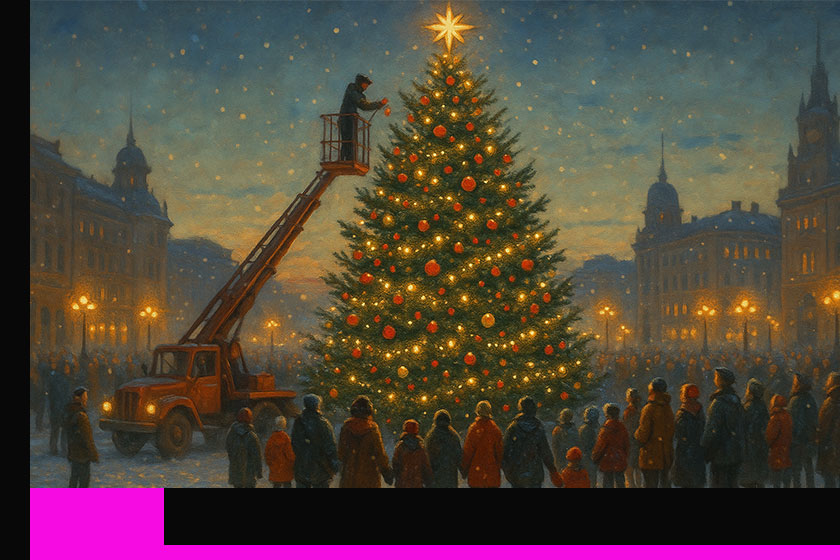
For many in December the humble Christmas tree takes centre stage in our homes, church lobbies, and city squares. We decorate it, gather around it, and let its glow soften the cold nights. But have you ever wondered why the tree became one of the world’s most beloved symbols of Christmas? Here are a few historical facts:
1. Trees were used long before Christmas.
In parts of northern Europe, ancient peoples brought evergreen boughs indoors during the darkest winter months as a sign of life that refused to die. Their green branches whispered hope: life can survive the winter cold and darkness.
2. In 1515, a German town built a giant tree for its youth.
They decorated it with apples, nuts, and ribbons—then shook the tree for the young people to gather treats. (Imagine adding that to the church foyer!)
3. The first recorded Christmas tree in North America dates to 1781 in Québec.
A German officer stationed there set up a decorated tree during the Revolutionary War era. From that quiet moment, the tradition slowly began to spread.
Whether the details are quaint, humorous, or surprising, one truth stands out: we’ve long looked to trees to remind us of life, beauty, abundance, and hope.
So maybe it’s no accident Scripture is full of trees reminding us of the sweeping story of God?
The Bible Is a Forest
From Eden to Revelation, the Bible is rooted—quite literally—in the story of trees.
The first pages of Scripture open with two trees:
the Tree of Life and the Tree of the Knowledge of Good and Evil. Humanity’s first calling, first temptation, and first failure all take place in the shade of branches.
The middle of the biblical story turns on a tree as well:
Jesus bore our sin on a tree (Acts 5:30, 1 Peter 2:24). The cross—our symbol of sacrifice and salvation—is, at its simplest, wood from a tree.
And the final chapter of Scripture ends with a tree:
the Tree of Life standing at the centre of the New Jerusalem, its leaves healing the nations (Revelation 22:2). The story that began with a broken tree ends with a restored one.
From Genesis to Revelation, God keeps drawing our eyes toward trees.
Trees teach us about life and growth.
Rings of growth form slowly, layer by layer—just like spiritual maturity. No shortcuts. No instant sanctification. Just faithful, rooted living.
Trees teach us about waiting.
A seed disappears into the soil long before it breaks through the surface. Advent carries the same quiet promise: something is growing, even when you cannot see it yet.
Trees teach us about resurrection.
Branches that looked dead in February blossom again in April. The pattern is familiar—death never gets the final word in the kingdom of God.
This December: Let the Trees Tell Their Stories
As you decorate your Christmas tree this year, or walk past evergreens dusted with snow, remember: God often uses simple, ordinary things to point us to profound truths.
In this month’s Tree Tales series, we’ll listen to the stories Scripture’s trees have been whispering for thousands of years—stories of promise, redemption, incarnation, and renewal. From the cedars of Lebanon to the fig tree Jesus cursed to the rugged wood of Calvary, each tree invites us to see God’s heart more clearly.
May every tree you see this season remind you of the God who plants, prunes, and makes all things new.